Superyachts create jobs, supply-chain demand and local spending, but that does not prove wealth concentration automatically benefits society. This article examines who gains, where money leaks away and what makes yacht spending produce wider value.
Few industries present the idea of wealth “trickling down” as visibly as the superyacht industry.
One wealthy individual commissions a yacht. The order employs naval architects, engineers, welders, electricians, carpenters, painters and project managers. Equipment is purchased from hundreds of suppliers. Once delivered, the yacht employs crew, buys fuel and provisions, pays marina and shipyard fees, undergoes maintenance and supports agents, brokers, technicians, hotels, restaurants and transport companies.
The money clearly does not remain entirely with the owner.
But does this prove that trickle-down economics works?
The answer depends on what is being claimed.
Superyacht expenditure undoubtedly creates real jobs and commercial activity. That is a measurable consequence of spending. It does not necessarily prove the broader political proposition that concentrating wealth among the richest members of society will automatically produce widespread prosperity.
To understand the difference, it is necessary to separate three ideas that are often treated as though they were the same:
- wealthy people spending money;
- economic multiplier effects; and
- trickle-down economic policy.
What is the trickle-down theory?
“Trickle-down economics” is not a single formal economic model. It is a widely used description of the belief that policies favouring high earners, investors or businesses will ultimately benefit the wider population.
The usual argument is that lower taxes, lighter regulation or greater returns at the top will encourage investment, business formation, consumption and employment. Wealth created or retained by those at the top is expected to flow through the economy in the form of jobs, wages, purchases and additional growth.
The phrase is usually used by critics rather than supporters of such policies.
Research from the International Monetary Fund has challenged the assumption that increasing the income share of the richest groups automatically produces stronger growth. An IMF study on inequality and growth found that increases in the income share of the top 20% were associated with lower subsequent economic growth, while increases in the income share of poorer and middle-income groups were associated with stronger growth.
OECD research has similarly concluded that rising inequality can weaken economic growth, partly because lower-income households have fewer opportunities to invest in education, skills and their own economic potential.
This does not mean that expenditure by wealthy people creates no benefit. It means that individual examples of spending cannot, by themselves, establish that greater concentration of income and wealth is the best route to prosperity for society as a whole.
Why superyachts are presented as an example
The superyacht industry often argues that a yacht should not be viewed merely as an expensive possession.
A superyacht is effectively a small floating organisation. It must be designed, built, crewed, maintained, insured, supplied, repaired and managed throughout its working life.
Unlike some luxury assets that can be bought and stored with limited continuing expenditure, a large yacht creates substantial recurring demand.
The economic chain can include:
- design and naval architecture;
- shipyard construction;
- steel and aluminium fabrication;
- engines, generators and propulsion systems;
- electrical and electronic equipment;
- interiors, furniture and specialist finishes;
- classification and surveying;
- insurance, finance and legal services;
- captains and crew;
- fuel and lubricants;
- marinas and port services;
- maintenance and refit;
- provisions and hospitality;
- yacht agents and management companies;
- tenders, watersports equipment and support vessels;
- air and ground transport; and
- local tourism spending.
This labour-intensive and service-intensive structure makes the superyacht industry a particularly visible example of spending by the very wealthy creating work for other people.
Does Superyacht Wealth Trickle Down? Infographic
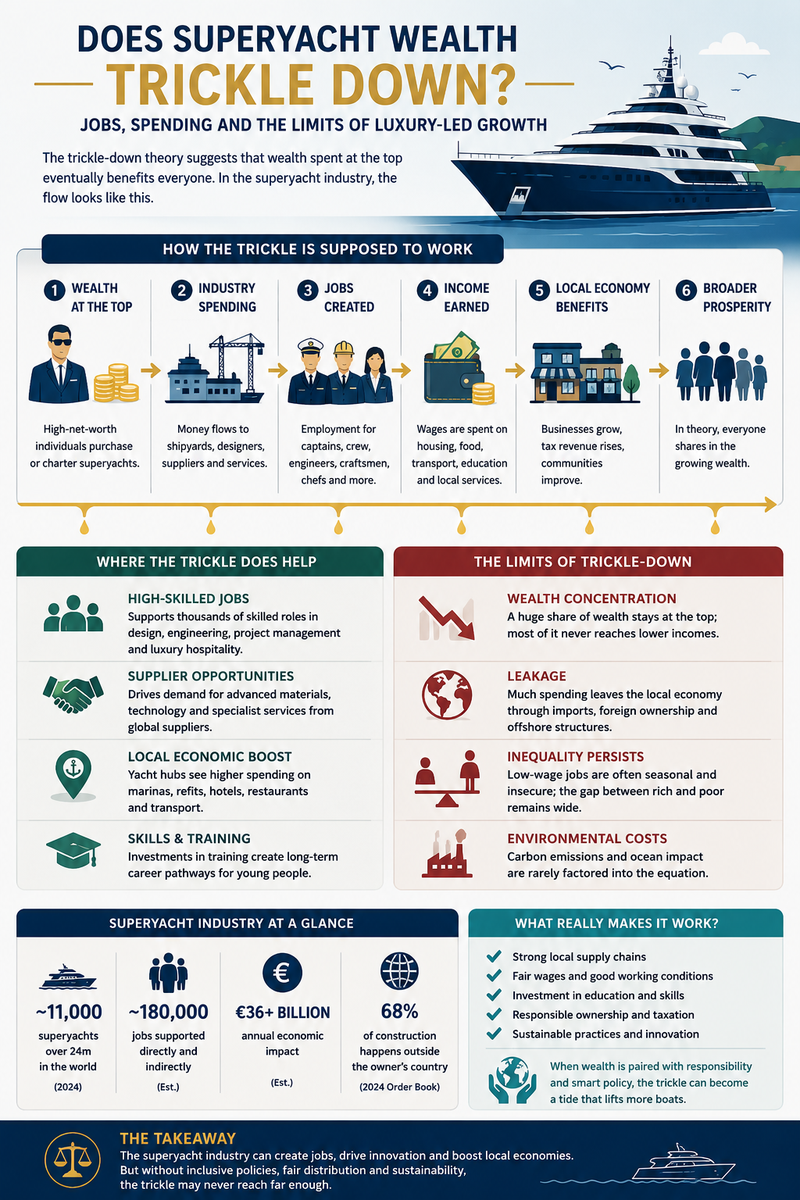
The first flow of money: building the yacht
The clearest economic impact occurs when an owner signs a construction contract.
The shipyard receives the order, but the entire contract value does not remain with the yard. Money is paid to employees, subcontractors, component manufacturers, designers, consultants and specialist suppliers.
Large custom yachts require extensive manual and technical work. The workforce may include highly specialised engineers and craftspeople whose skills have been developed over many years.
Industry estimates have suggested that hundreds of people can be directly involved in a single large-yacht construction project before wider supply-chain employment is counted. These estimates should be treated as industry impact claims rather than universal figures because employment requirements vary greatly by yacht size, shipyard and construction method.
In this situation, part of the owner’s accumulated wealth is converted into:
- employee wages;
- contractor income;
- supplier revenue;
- business profits;
- taxes and social contributions; and
- investment in tools, facilities and training.
This is genuine distribution through commercial exchange. The workers do not receive money as a gift from the owner; they receive it in return for labour, skill, materials and services.
Direct, indirect and induced effects
Economic-impact studies usually divide benefits into several categories.
Direct effects
These are the immediate activities created by the spending.
For a new yacht, direct effects might include shipyard employment, naval architecture, project management and purchases made by the builder.
For an operational yacht, they include crew salaries, fuel, marina fees, maintenance and provisioning.
Indirect effects
These occur within the supply chain.
An engine manufacturer buys metal, electronics and professional services. A shipyard buys paint, cables, glass, tools and safety equipment. A marina purchases electricity, security, cleaning and maintenance services.
Induced effects
Employees and business owners then spend some of their income on housing, food, clothing, transport and other household needs.
Official input-output methodologies use multipliers to estimate how a change in final demand affects output, employment and earnings across a regional economy. These models distinguish the initial expenditure from subsequent rounds of supply-chain and household spending.
The United States Bureau of Economic Analysis RIMS II methodology is one example of a formal multiplier framework.
This is an important distinction: an economic multiplier is a technical estimate of how expenditure circulates. It is not proof that wealth concentration itself produces fair or optimal outcomes.
Evidence of substantial economic activity
There is credible evidence that yacht construction and operation support significant economic activity.
An early global industry study, based on 2010 activity, estimated that superyachts contributed approximately €24 billion to the world economy. It attributed €13.76 billion to direct activity and €10.24 billion to indirect activity.
It also estimated between 130,000 and 150,000 land-based jobs, approximately 33,000 crew positions and around 100,000 contractor and day-worker roles.
These figures are now historical and came from an industry study, so they should not be presented as a current audited global total.
More recent national research illustrates the scale of the wider nautical economy.
An Altagamma-Deloitte study reported that Italy’s nautical sector generated an estimated total economic impact of €27.7 billion in 2022 and supported approximately 157,000 jobs.
The study covered the broader yachting sector, including construction, refit and marine tourism—not superyachts alone. It estimated an overall economic multiplier of about 2.7.
The study reported that yachts over 18 metres represented a disproportionate share of economic activity and that large-yacht spending in local areas was substantially higher than average nautical-tourism spending.
A separate industry study of professional yachting in Genoa estimated that yacht visits during 2020 generated a cumulative economic impact of €354 million and activity equivalent to approximately 2,100 jobs. Estimated daily economic impact increased sharply with yacht size.
These studies support the proposition that superyachts generate commercial activity. They do not, on their own, determine whether the resulting distribution is fair, whether public concessions are justified or whether another use of the same resources would produce greater social benefit.
The yacht continues spending after delivery
The economic effect of a superyacht does not end at launch.
A large yacht may operate for decades. During that time, it normally requires:
- permanent crew;
- management and administration;
- insurance;
- flag and classification services;
- fuel;
- marina berths;
- winter storage;
- repairs and surveys;
- engine and generator servicing;
- repainting;
- replacement equipment;
- food, drinks and guest supplies;
- transport and travel; and
- periodic refits.
This recurring expenditure is one reason the superyacht sector can support established clusters in places such as northern Italy, the Netherlands, Germany, France, Spain, the United Kingdom, Malta, Greece, Turkey, the United States, Australia and New Zealand.
A yacht may be built once, but it must be operated and maintained every year.
Crew as a channel of distribution
Crew salaries are among the most direct ways in which owner expenditure reaches individual workers.
A yacht may employ captains, engineers, officers, deckhands, chefs, stewards, pursers and specialist personnel.
Crew members spend their salaries on homes, families, education, travel, services and consumer goods. Some of that spending occurs in the yacht’s cruising region, while some occurs in the crew member’s home country.
This means the benefit can be geographically dispersed.
A marina town may receive spending from crew during a refit period, while a crew member’s family may receive income in another country. From a global perspective, both are economic effects. From the perspective of a local authority deciding whether to invest in a superyacht marina, only locally retained spending may be relevant.
The quality of employment also matters. A job should not be judged only by the salary paid. Working hours, rest, safety, accommodation, contractual protection, training and long-term career opportunities affect the true value of employment.
Local spending by yachts
When a yacht enters a destination, it may pay for:
- berthing;
- fuel;
- electricity;
- waste collection;
- fresh water;
- pilotage and port services;
- customs and immigration support;
- local agents;
- food and beverages;
- flowers and guest supplies;
- taxis and rental vehicles;
- restaurants and hotels;
- repair technicians;
- diving and watersports services;
- entertainment and excursions.
A large yacht with guests aboard can produce significant expenditure over a relatively short visit.
This is the strongest version of the superyacht trickle-down argument: money held by a wealthy owner is spent directly in coastal communities and supports businesses that may have no direct connection to the owner’s original source of wealth.
In this narrow sense, spending does flow downward and outward.
But the size of the original invoice does not reveal how widely the benefit is shared.
Where the money can stop
Not every euro spent by a yacht continues circulating locally.
Part of the money may leave the region through what economists call leakage.
Leakage can occur when:
- equipment is imported;
- fuel is supplied by an international company;
- profits are transferred to owners outside the region;
- specialist contractors are flown in from abroad;
- crew remit earnings to their home countries;
- food and luxury goods are imported;
- insurance and management services are based elsewhere;
- vessels are owned through foreign companies; and
- debt payments go to international lenders.
Input-output analysis recognises that imported goods and services reduce the size of local multiplier effects because subsequent rounds of spending occur outside the region.
A destination with strong local shipyards, suppliers, training institutions and skilled workers may retain a much larger share of yacht expenditure than a destination that merely provides a berth and imports nearly everything else.
Gross spending is not the same as local prosperity
Economic-impact announcements often emphasise the largest available number.
That number may represent gross output rather than wages, profit, tax revenue or value added.
Suppose a yacht spends €1 million in a region. That does not mean local households become €1 million wealthier.
The total can include:
- imported materials;
- fuel taxes;
- supplier costs;
- depreciation;
- payments to foreign businesses;
- business profits;
- wages;
- financing costs; and
- repeated counting of transactions through the supply chain.
A more informative assessment asks:
- How much value was created locally?
- How much became employee income?
- How much tax was collected?
- How much profit remained in the region?
- What proportion went to small and medium-sized businesses?
- Were the jobs permanent, seasonal or temporary?
- What public costs accompanied the activity?
- Which groups received the benefit?
Without these questions, “economic impact” can become a promotional phrase rather than a complete account.
Does yacht spending prove trickle-down economics?
No.
It proves that purchasing a highly labour-intensive product creates demand for labour and supplies.
That principle applies to many forms of spending. Building a hospital, railway, hotel, factory, wind farm, university or yacht will all create direct and supply-chain activity.
The more difficult policy question is not whether spending produces activity. It is whether society should encourage wealth concentration on the assumption that private luxury consumption will produce better outcomes than alternative distributions of income, investment or public expenditure.
The IMF and OECD evidence does not support a general assumption that increasing the income share of the richest groups automatically raises growth or improves living standards for everyone else.
Superyachts therefore demonstrate a spending effect, but they do not validate the entire trickle-down theory.
A yacht may distribute more spending than some luxury assets
There is nevertheless an important distinction between a superyacht and a passive store of wealth.
Money placed into an appreciating financial or property asset may generate limited immediate employment after the purchase is completed.
A superyacht normally requires continuous expenditure.
It needs people to design it, build it, operate it, clean it, repair it, supply it and manage it. Much of the expenditure cannot be automated or eliminated without making the yacht unusable.
From this perspective, a yacht may distribute a greater proportion of its purchase and ownership cost through labour and service businesses than some other luxury assets.
That does not make the yacht socially costless. It means the structure of yacht expenditure is unusually labour-intensive.
Who benefits most?
The answer varies across the yacht’s lifecycle.
During construction, the principal beneficiaries may include:
- the shipyard;
- equipment manufacturers;
- subcontractors;
- skilled trades;
- designers;
- engineers; and
- local manufacturing clusters.
During operation, benefits may shift towards:
- crew;
- managers;
- marinas;
- fuel suppliers;
- refit yards;
- agents;
- provisioners; and
- tourism and hospitality businesses.
The owner also benefits. The owner receives the use, privacy, mobility, status and personal enjoyment of the yacht.
This matters because trickle-down arguments sometimes describe the owner’s expenditure as though it were primarily philanthropic.
It is not.
The owner is purchasing a private benefit. Employment and wider spending are economically important consequences of that purchase, but they are not normally its principal purpose.
Taxation and public revenue
The amount that reaches the public depends heavily on the jurisdiction, ownership structure, registration, commercial status and use of the yacht.
Potential public revenues include:
- income tax and social contributions from workers;
- corporation tax on business profits;
- value-added or sales taxes;
- import duties;
- fuel duties;
- port and registration fees;
- property or concession payments from marinas; and
- tourism-related taxes.
However, international ownership structures, foreign registration, temporary importation rules and commercial charter arrangements can make the tax position complex.
It would be inaccurate to assume either that all yacht owners avoid tax or that every yacht pays the same level of tax as an equivalent domestically owned asset. The result depends on the facts, applicable law and effective enforcement.
A credible economic-impact report should therefore distinguish private spending from public revenue. They are not interchangeable.
Public investment and opportunity cost
Governments and local authorities sometimes invest in marina extensions, dredging, roads, security, utilities or promotional programmes intended to attract large yachts.
Such investment may be justified where additional tax revenue, employment and local business activity exceed the public cost.
But every public investment has an opportunity cost.
Money and waterfront land used for superyacht facilities cannot simultaneously be used for every alternative purpose. Possible alternatives may include commercial port activity, fishing, public access, housing, environmental restoration or other forms of tourism.
The correct policy question is not simply whether yachts spend money. It is whether the public receives an adequate return after all financial, social and environmental costs are considered.
Environmental costs complicate the calculation
A conventional economic-impact figure may count fuel sales, repairs and construction as positive activity without subtracting the environmental costs associated with them.
Fuel consumption generates economic output for suppliers and tax revenue for governments, but it also generates greenhouse-gas emissions and air pollution.
A refit creates employment, but it can also generate waste and consume substantial materials and energy.
Marina development can support tourism while affecting coastal ecosystems or public access.
An economic activity can therefore produce jobs and impose costs at the same time.
A complete assessment should not present gross expenditure as though it were equivalent to net social benefit.
Inequality and visibility
Superyachts are especially controversial because they make extreme wealth visible.
A factory, investment portfolio or private company may represent greater wealth than a yacht but attract less attention. A superyacht occupies public waters and highly visible harbours.
This creates a conflict between two valid observations:
- The yacht supports real workers, businesses and communities.
- The yacht is evidence that one person controls resources far beyond those available to most people.
The first observation does not invalidate concerns about inequality. The second does not erase the livelihoods supported by the industry.
A serious analysis must be capable of holding both ideas at once.
The danger of defending every form of wealth through employment
Almost any expensive activity can be defended by saying that it creates jobs.
A wasteful project creates employment while it is being built. Repeatedly replacing usable interiors creates work. Burning additional fuel increases supplier revenue.
But employment alone does not establish that an activity is efficient, sustainable or fair.
The relevant questions include:
- Is the work productive and properly rewarded?
- Are environmental and public costs paid by the beneficiary?
- Could the same resources produce greater benefit elsewhere?
- Is the activity dependent on favourable tax treatment?
- Are local communities receiving a reasonable share?
- Does the industry build transferable skills and durable businesses?
- Are the claimed multiplier effects based on reliable data?
The existence of jobs is important, but it should be the beginning of the analysis rather than the end.
Making the benefits spread more widely
The economic benefits of superyachting do not have to be left to chance.
Governments, industry bodies, shipyards, managers and owners can deliberately improve how expenditure is distributed.
Local procurement
Yachts and shipyards can use capable local suppliers rather than automatically importing every product and service.
This keeps a greater proportion of spending within the destination.
Training and apprenticeships
Investment in apprenticeships, engineering education and maritime skills can turn temporary demand into lasting human capital.
Workers retain their skills even if they later move into commercial shipping, renewable energy, manufacturing or other industries.
Fair employment
Strong contracts, timely payment, safe conditions and proper rest ensure that economic value reaches workers rather than being captured only by businesses and intermediaries.
Transparent taxation
Clear, stable and enforceable rules allow owners and businesses to understand their obligations while giving the public confidence that the industry is contributing fairly.
Environmental responsibility
Charging users for environmental damage and requiring cleaner technology prevents economic benefits from being achieved by transferring costs to the public.
Locally retained infrastructure value
Marina and shipyard development should create facilities, training and businesses that continue benefiting the community rather than functioning as isolated luxury enclaves.
Better impact reporting
Studies should publish:
- the year assessed;
- the geographic boundary;
- direct, indirect and induced effects separately;
- gross output and value added separately;
- wages and employment;
- public revenue;
- imports and leakage;
- public subsidies;
- environmental costs; and
- the assumptions behind multipliers.
This would make it easier to distinguish reliable evidence from industry promotion.
From trickle-down to negotiated distribution
The phrase “trickle down” implies that society should wait passively for wealth to descend from the top.
The superyacht industry demonstrates that distribution is not automatic. It depends on contracts, wages, suppliers, tax rules, labour standards, marina policy, ownership structures and environmental regulation.
A yacht built in a region with strong local supply chains and fair employment practices may distribute substantial value.
A yacht built with imported components, weak labour protections and limited local taxation may produce impressive gross spending while allowing much of the value to leave the community.
The difference is created by institutions and decisions—not by an economic law requiring wealth to trickle down.
The honest conclusion
Superyachts create real employment and economic activity.
They support shipyards, skilled trades, crew, engineers, designers, marinas, suppliers and coastal businesses. Their construction and operation can direct substantial private wealth into wages, purchases and services.
Those benefits should not be dismissed simply because the original expenditure comes from an extremely wealthy individual.
But the existence of those benefits does not prove that greater inequality is desirable or that policies enriching the wealthiest people will automatically improve conditions for everyone else.
The strongest defensible claim is narrower:
When a wealthy person spends money on a labour-intensive asset such as a superyacht, part of that money is distributed through employment, supply chains, taxation and local expenditure.
How much reaches ordinary workers and communities depends on where the yacht is built, how it is operated, who supplies it, how workers are treated, how profits are distributed and how effectively taxes and environmental costs are managed.
Superyachts do not prove that wealth inevitably trickles down.
They show that wealth can be made to circulate—but only when people, businesses and governments create the channels through which it flows.