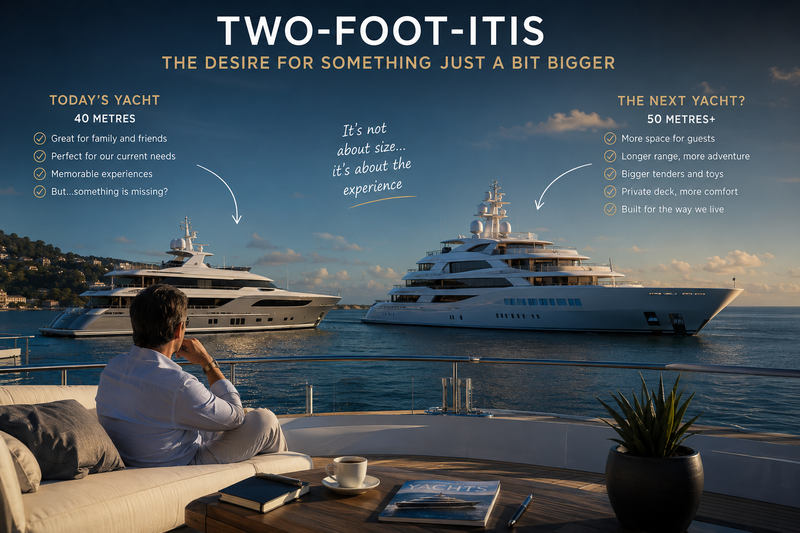
Two-foot-itis is the boating industry's humorous name for the persistent desire to buy a slightly larger yacht. Superyacht Guide examines whether the phenomenon is real, what drives it and why bigger is not always better.
A yacht owner takes delivery of the boat they have spent months—or perhaps years—selecting, purchasing or building.
It should be the end of the search. Instead, the owner soon begins looking at something larger.
Perhaps the next yacht has one more guest cabin, a larger tender garage, a private owner's deck, additional crew accommodation or a beach club that the present yacht cannot provide. What begins as a casual glance at brokerage listings can become a serious conversation with a broker.
Within recreational boating, this desire is often called two-foot-itis, although the same expression appears as three-foot-itis, five-foot-itis or even ten-foot-itis.
The number is not important. The meaning is always similar: however large the current boat may be, its owner starts believing that a little more length would solve its shortcomings.
Brokers, builders and owners frequently joke about the condition. But is it really common, and why does it happen?
Is two-foot-itis real?
Two-foot-itis is not a medical or formally recognised psychological condition.
It is boating-industry slang describing a recognisable pattern of ownership: buying a boat, using it, discovering its limitations and then considering a larger replacement.
The expression has been used for many years in boating publications, sales discussions, owner communities and brokerage advertising. It is common enough to be understood immediately by many boat owners.
However, there does not appear to be a comprehensive public study showing what percentage of yacht owners eventually move to a larger vessel.
The evidence is therefore mainly observational and commercial rather than scientific.
Brokers see existing owners return to the market. Shipyards regularly announce projects for repeat clients. Yacht listings sometimes state that the seller is moving to a larger vessel. Owners themselves talk about progressing through several boats as their experience, ambitions and requirements grow.
That does not mean everyone does it.
Some owners keep the same yacht for decades. Others refit rather than replace it. Some eventually downsize after discovering that a smaller yacht is easier, less expensive and more enjoyable to operate.
Two-foot-itis is real as a behaviour, but it is not inevitable.
The first yacht teaches the owner what they actually need
Many buyers do extensive research before purchasing their first substantial yacht, but research cannot entirely replace ownership experience.
A prospective owner may believe that four guest cabins are sufficient, only to discover that family members, friends, children, assistants and security personnel regularly travel together.
A tender that appeared adequate at a boat show may prove too small for the owner's preferred cruising programme. Storage spaces that looked generous may fill rapidly with diving equipment, water toys, luggage, provisions and spare parts.
After a season onboard, an owner may identify requirements that were not obvious during the original purchase:
- An additional guest cabin.
- Greater crew separation and privacy.
- A larger galley and more cold storage.
- Better access to the water.
- A larger or more capable tender.
- More space for water toys.
- Longer range and greater fuel capacity.
- Improved stability and comfort underway.
- A dedicated office, gym or cinema.
- A private owner's deck.
- Additional laundry and service areas.
- Better circulation between interior and exterior spaces.
The desire for a larger yacht is therefore not always caused by vanity or status. It can be the result of learning how the yacht is actually used.
The first yacht may serve as a highly expensive but extremely effective design brief for the second.
Yachts can appear to become smaller after delivery
A yacht can feel enormous during an inspection, boat show or delivery ceremony.
It may feel very different once it is fully operational.
Crew members occupy working and living areas. Tenders and equipment fill garages. Provisions require storage. Guests bring luggage. Technical spaces consume a substantial portion of the hull. Safety equipment, machinery, tankage and service corridors all compete for volume.
A yacht that appeared spacious when empty can feel considerably smaller when 10 or 12 guests and a full crew are onboard.
The effect becomes more noticeable during longer cruises. On a weekend trip, limited storage or shared areas may be acceptable. During a month-long family voyage, the same compromises may become persistent irritations.
Owners may also find that the spaces they use most are not the spaces that received the greatest attention during the original design.
A spectacular formal dining room may remain largely unused, while the aft deck becomes crowded at every meal. A large main saloon may matter less than the absence of a shaded outdoor lounge or convenient beach-club bathroom.
The owner is not necessarily becoming unreasonable. Their understanding of the yacht is becoming more precise.
Length is not the same as usable space
The phrase two-foot-itis focuses on length, but additional length does not always provide the improvement an owner expects.
Two yachts of similar length can have very different:
- Beams.
- Gross tonnages.
- Deck counts.
- Interior volumes.
- Hull forms.
- Ceiling heights.
- Crew arrangements.
- Tender storage.
- Exterior deck areas.
Gross tonnage is associated with internal volume, not the yacht's weight. In the superyacht market, it can therefore reveal more about usable enclosed space than length alone.
A wide-beam 45-metre yacht may feel substantially larger than a narrow 48-metre yacht. A yacht with a full-beam owner's suite, efficient crew routes and well-planned storage may work better than a longer vessel with an unsuitable layout.
This means an owner may not really need two more feet.
They may need better use of the feet they already have.
Before moving to a larger yacht, an owner should identify precisely which problem is being solved. Otherwise, the new vessel may be longer without being noticeably more suitable.
Repeat ownership is established in the superyacht market
The superyacht industry contains many experienced owners who have commissioned, purchased or operated several yachts.
Shipyards value repeat clients because an experienced owner already understands the building process, operational compromises and level of customisation required.
Repeat owners also tend to arrive with more detailed instructions.
They know which spaces worked on their previous yacht, which remained unused and which operational problems they do not want repeated.
In some cases, the replacement yacht is larger. In others, it remains within a similar size range but offers more volume, different capabilities or a more specialised cruising programme.
An owner might move from a conventional motor yacht to:
- A long-range explorer yacht.
- A fast aluminium yacht.
- A shallow-draught Bahamas cruiser.
- A sailing yacht.
- A larger-volume displacement yacht.
- A yacht supported by a separate shadow vessel.
- A smaller yacht that is easier to use spontaneously.
The significant point is not always growth in length. It is progression towards a yacht that more closely reflects the owner's lifestyle.
The psychological appeal of the next yacht
Practical needs explain much of two-foot-itis, but psychology can also play a part.
Novelty fades
Taking delivery of a yacht is an exceptional experience. The vessel is new, unfamiliar and full of possibilities.
Over time, the owner becomes accustomed to it. Features that once felt extraordinary become normal.
This is consistent with the broader psychological idea of hedonic adaptation: people often adjust to improvements in circumstances, and the initial emotional impact gradually reduces.
The yacht has not become worse. The owner's expectations have changed.
A larger or more advanced yacht promises to recreate the excitement of choosing, designing and taking delivery of something new.
Owners become aware of new possibilities
Ownership exposes clients to other yachts, designers, shipyards and cruising programmes.
An owner may visit a friend's yacht and discover an arrangement they had never considered. They may see a better beach club, quieter propulsion system, more private owner area or more efficient tender operation.
Yacht shows also bring different designs into direct comparison.
Once an owner knows that a particular feature is possible, its absence from the existing yacht may become increasingly noticeable.
Social comparison
Yachting is a social environment. Yachts gather in the same marinas, anchorages, regattas and events.
Owners may compare size, design, technology, tenders and amenities, even when competition was not the original reason for purchasing a yacht.
For some buyers, the desire to upgrade may partly involve prestige or the wish to own something distinctive.
However, it would be misleading to assume that all larger-yacht purchases are primarily displays of wealth. Many experienced owners are highly private and focus more on comfort, family time, cruising ability or technical performance than public recognition.
The design and building process can itself become addictive
Some owners enjoy creating a yacht almost as much as using it.
Working with naval architects, designers, engineers and shipyards gives them the opportunity to solve complex problems and produce something entirely personal.
After completing one yacht, they may begin thinking about what they would do differently next time.
For these clients, the next build is not simply another purchase. It is another major creative and technical project.
Why a small increase can become a very large increase
At the smaller end of boating, two-foot-itis may literally mean moving from a 28-foot boat to a 30-foot boat.
In the superyacht market, the increase is often much greater.
An owner moving from a 40-metre yacht may conclude that a meaningful improvement requires 50 metres rather than 42. An owner seeking a private deck, helicopter capability, larger tenders and additional crew accommodation may need an entirely different class of vessel.
Once the project begins, requirements accumulate:
- More guests require more cabins.
- More cabins require more interior volume.
- More guests require additional crew.
- More crew require larger crew areas.
- Larger tenders require more garage space.
- Longer voyages require greater stores and tank capacity.
- More equipment requires more technical support.
- Additional decks increase weight and engineering demands.
The proposed yacht can grow rapidly as each requirement affects another part of the design.
What begins as a request for slightly more space may become a yacht substantially larger and more complex than its predecessor.
The financial consequences of moving up
A larger yacht normally means more than a larger purchase price.
It may require:
- More crew.
- Higher salaries and employment costs.
- Greater fuel consumption.
- More expensive berthing.
- Increased insurance.
- Larger maintenance and refit budgets.
- More costly haul-out and shipyard facilities.
- Additional tenders and equipment.
- Higher provisioning and logistics costs.
- More complex regulatory and management support.
Annual operating costs vary considerably. Superyacht Guide uses 14 per cent of a yacht's value as an approximate annual operating-cost estimate where no reliable yacht-specific budget is available.
Using that planning method:
- A yacht valued at €10 million could require approximately €1.4 million annually.
- A yacht valued at €25 million could require approximately €3.5 million annually.
- A yacht valued at €50 million could require approximately €7 million annually.
These are broad estimates, not quotations. The real cost depends on the yacht's age, usage, location, crew, condition, fuel consumption, charter activity and maintenance programme.
Moving to a larger yacht can also take the owner across important size, tonnage, certification and operational thresholds.
The next yacht should therefore be assessed as a complete operating enterprise, not simply as a larger version of the current boat.
The hidden cost of selling too soon
An owner who decides to upgrade shortly after delivery may suffer a substantial financial loss.
The yacht may have been heavily customised to personal preferences that do not increase its resale value. Brokerage commission, legal costs, surveys, repairs, marketing, repositioning and price negotiation all affect the net proceeds.
A newly delivered yacht may also enter the resale market before establishing a strong operational history.
If the owner simultaneously commissions a new build, they may face several years of design and construction while continuing to operate or sell the existing yacht.
The desire for something larger should therefore be tested carefully before a sale or build contract begins.
Temporary dissatisfaction after seeing a newer yacht is not the same as a genuine operational requirement.
When upgrading makes sense
Moving to a larger yacht can be entirely rational when the current yacht consistently prevents the owner from following the programme they want.
An upgrade may be justified when:
- The regular guest group has outgrown the accommodation.
- The yacht lacks the range or seaworthiness required for future cruising.
- Crew and guest circulation creates privacy or service problems.
- Essential tenders and equipment cannot be carried safely.
- The owner needs facilities that cannot be added during a practical refit.
- The yacht's age is producing unacceptable downtime.
- Charter demand would support a different layout or capacity.
- The owner now understands their long-term requirements clearly.
- The financial and operational consequences are fully acceptable.
In these circumstances, a larger yacht may deliver significantly more useful time, comfort and capability.
When a refit may be the better cure
Not every case of two-foot-itis requires a new yacht.
A carefully planned refit may improve:
- Storage.
- Lighting.
- Interior circulation.
- Crew service routes.
- Exterior shade.
- Furniture arrangements.
- Audio-visual and communications systems.
- Stabilisation.
- Tender handling.
- Beach-club access.
- Galley capability.
- Energy efficiency.
Removing poorly used furniture or changing the purpose of an underused room can make a yacht feel substantially larger.
A yacht may also gain useful flexibility through a chase boat or support vessel, allowing tenders, water toys, dive equipment and additional stores to be carried separately.
Before selling, the owner should compare the cost, disruption and outcome of a refit with those of purchasing or building another yacht.
Why some owners eventually downsize
Two-foot-itis can work in reverse.
After owning increasingly large yachts, some owners decide they want:
- Fewer crew.
- Lower costs.
- Easier access to smaller ports.
- More spontaneous use.
- Less management.
- Simpler systems.
- A closer connection with the water.
- Greater privacy with fewer people onboard.
A very large yacht can provide extraordinary capability, but it also requires an extensive organisation to operate.
Some owners discover that their most enjoyable time on the water occurs aboard a smaller yacht, sailing boat, chase boat or dayboat.
Experience may therefore lead an owner upwards in size—and later bring them back down.
Questions to ask before buying the next yacht
- Which specific limitations of the current yacht need to be resolved?
- Are those limitations caused by length, volume, layout or equipment?
- Could a refit solve them?
- How many guests actually travel regularly?
- Which onboard spaces are used most and least?
- What cruising programme will the next yacht undertake?
- What tenders and equipment genuinely need to be carried?
- How many additional crew members will be required?
- What will the annual operating budget become?
- Is the attraction to the new yacht practical, emotional or both?
- Would chartering a larger yacht first test the requirement?
- Would a different type of yacht be more useful than a longer one?
Chartering is particularly valuable. An owner considering a move from 40 to 50 metres can charter within the proposed size range and experience the differences before committing to a purchase.
So, is two-foot-itis true?
Yes—but not in the simplistic sense that every yacht owner is never satisfied.
The phenomenon describes a real and widely recognised tendency for some owners to seek a larger or more capable yacht after gaining experience with their existing vessel.
Sometimes it is driven by status, novelty or comparison. More often than outsiders might assume, it is driven by practical knowledge.
The owner learns how many people really travel, which spaces matter, what equipment is used and where the existing yacht compromises the experience.
The danger lies in believing that length alone will solve every problem.
A successful upgrade begins not with the question, “How much bigger should the next yacht be?” but with a more useful one:
“What should the next yacht allow us to do that this yacht cannot?”
The answer may require two more feet, twenty more metres, a better layout, a major refit—or no change at all.
Sources and further reading
- Boats.com — boat ownership and the desire to move to a larger boat
- Boat International — gross tonnage and yacht volume
- Heesen — repeat yacht ownership and custom yacht development
- National Library of Medicine — research concerning hedonic adaptation
Editorial note: Two-foot-itis is informal boating-industry terminology rather than a medical diagnosis. The financial figures in this article are broad planning estimates and not yacht-specific operating quotations.