White glove service promises discreet, personalised attention. Superyacht Guide compares how elite yacht crews deliver it with the systems, staffing and standards of five-star hotels.
“White glove service” is one of the most frequently used expressions in luxury travel. It suggests discretion, immaculate presentation, personal attention and a willingness to handle every detail for the client.
In the superyacht industry, however, the phrase describes something more demanding than polished food service or a perfectly prepared guest suite. A yacht is simultaneously a private residence, luxury hotel, restaurant, transport system, watersports centre and working vessel.
The closest comparison is the service offered by a leading five-star or ultra-luxury hotel. Both environments seek to make guests feel recognised, comfortable and understood, but the conditions under which that service is delivered are very different.
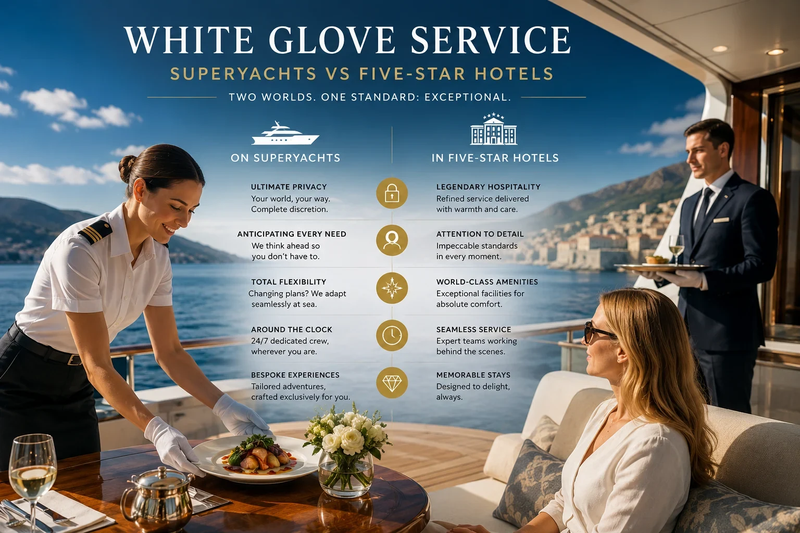
White glove service in both environments depends on personalisation, anticipation, discretion and consistently high standards.
What does white glove service mean?
White glove service is not a regulated qualification or a single formal standard. It is better understood as a promise of highly personalised, end-to-end assistance.
At its best, it means:
- remembering individual preferences;
- anticipating needs without becoming intrusive;
- coordinating requests discreetly;
- presenting spaces, meals and equipment impeccably;
- solving problems without transferring the difficulty to the guest;
- protecting privacy;
- communicating consistently across the team; and
- offering safe alternatives rather than simply refusing a request.
The quality of the experience depends less on visible luxury than on how the guest is treated. Five-star hospitality standards place particular emphasis on service because the emotional experience of a visit matters alongside the physical surroundings.
The principles shared by yachts and luxury hotels
The best yacht crews and hotel teams rely on many of the same principles.
Anticipatory service
Luxury service should not feel purely reactive. Staff notice patterns, prepare in advance and remove inconvenience before it becomes apparent.
In a hotel, that might mean arranging a preferred newspaper, preparing a familiar table or knowing that a returning guest requires an early airport transfer.
On a yacht, anticipation may involve having towels, refreshments and watersports equipment ready before guests reach the swim platform; adjusting a cabin before an overnight passage; or coordinating a tender, restaurant reservation and security arrangements without requiring repeated instructions.
Personalisation
True personalisation goes beyond addressing a guest by name. It involves understanding how that person prefers to travel, eat, socialise, rest and communicate.
The same principle applies in a leading hotel, but yacht crews can develop a more detailed knowledge of individual habits because they serve a much smaller group for prolonged periods.
Discretion
Both hotels and yachts may serve public figures, business leaders and high-profile families. Staff must protect personal information, conversations, movements and preferences.
On a private yacht, the requirement can be even more sensitive. Crew work inside the owner’s living environment and may witness private family life, business discussions, medical matters and security arrangements.
Discretion is therefore not simply polite silence. It includes careful handling of photographs, social media, guest information, itineraries and communications.
Consistency
A single impressive moment does not create luxury service. The experience must remain dependable throughout the stay.
Cabins must be prepared correctly each day. Meals must arrive at the expected standard. Requests must be passed accurately between departments. Guests should not have to repeat the same preference to several people.
This consistency depends on communication, training and disciplined operating procedures rather than personality alone.
Where a five-star hotel has the advantage
A top hotel normally operates from a permanent, purpose-built property with established departments and substantial support infrastructure.
It may have separate teams for reception, housekeeping, room service, restaurants, concierge, engineering, security, spa operations, events, laundry and guest relations.
If a problem arises, the hotel can often call on additional staff, replacement equipment, nearby suppliers or specialist contractors. Employees usually work defined shifts and then leave the property.
Hotels can also design highly repeatable service procedures. The route from reception to a suite does not change. Kitchens remain in one location. Storage and laundry capacity are comparatively extensive. Local restaurants, transport operators and medical providers are already known.
Where superyacht service becomes more demanding
A superyacht has far fewer people and much less space, yet may be expected to reproduce many of the functions of a luxury resort.
Crew members often perform several roles. An interior crew member may serve breakfast, prepare cabins, organise flowers, manage laundry, make cocktails, help with an event and prepare the yacht for departure within the same day.
Skills from luxury hotels, restaurants and resorts transfer well into yachting. Silver service, bartending, laundry, flowers, wine knowledge and guest relations are all valuable foundations for yacht interior roles.
The difference is that the service takes place on a moving vessel.
Weather may prevent an intended anchorage. A marina berth may become unavailable. Guests may change the itinerary at short notice. Supplies can be difficult to obtain in remote areas. A tender transfer may be delayed by sea conditions.
The crew must adapt without making the disruption the guest’s problem.
A private environment rather than a public property
Hotel guests normally retain a degree of separation from staff. They can leave the property, close their suite door or move between public areas.
On a yacht, guests and crew occupy the same limited environment, sometimes for weeks. Crew may be visible from breakfast until late at night, while continuing to work behind the scenes before guests wake and after they retire.
This makes service style especially important. Attentiveness can quickly feel intrusive when space is limited.
Exceptional yacht service therefore includes knowing when not to approach, when to reduce formality and when to allow guests to feel that the yacht belongs entirely to them.
The owner-preference system
Luxury hotels usually keep guest profiles recording information such as room preferences, allergies, arrival details or previous requests.
A professionally managed yacht may maintain a far more detailed owner and guest preference system. It can cover:
- preferred cabin temperature;
- pillow and linen choices;
- food sensitivities and favourite dishes;
- beverage brands and serving temperatures;
- daily routines;
- table settings;
- music and entertainment;
- exercise habits;
- watersports preferences;
- privacy requirements;
- children’s routines;
- cultural and religious considerations; and
- preferred communication style.
The purpose is not to collect information unnecessarily. It is to prevent the owner or guest from having to explain the same requirement repeatedly.
Sensitive preference information must be stored and discussed carefully, with access limited to those who need it for their role.
Food and beverage service
A five-star hotel may operate several specialised restaurants, each with its own kitchen team, equipment, menu and supply chain.
A yacht chef frequently works in one compact galley and may be expected to produce restaurant-level food across multiple cuisines. The chef must account for preferences, allergies, dietary regimes, children, crew meals and last-minute changes while managing limited cold storage and provisioning opportunities.
Interior crew must then match the food with appropriate table settings, wine service, timing and presentation.
The challenge is versatility. Breakfast may be informal, lunch may take place on deck, afternoon refreshments may be served by the water, and dinner may become a themed formal event, all within one day.
Housekeeping and presentation
Hotel housekeeping normally follows a predictable schedule and can draw on a sizeable linen inventory, central laundry and specialist maintenance teams.
On a yacht, housekeeping must work around guest movements, sea conditions and limited storage. Fabrics, artwork, marble, leather, polished surfaces and specialist finishes may require individual care.
The yacht must remain immaculate, but cleaning should happen as invisibly as possible. A cabin cannot feel as though staff are constantly entering it, even when it requires several services during the day.
Concierge service without a fixed location
A luxury hotel concierge develops deep knowledge of one city or destination.
A yacht crew may need to deliver comparable assistance in a different port every few days.
Requests can include:
- restaurant access;
- private aviation;
- vehicles and drivers;
- medical appointments;
- security;
- customs and immigration;
- entertainment;
- diving;
- guides;
- childcare;
- shopping;
- special events;
- delivery of rare products; and
- access to private venues.
The captain, purser, chief steward or yacht agent may coordinate these arrangements across jurisdictions and languages, often with very little notice.
Safety changes the meaning of service
This is the most important difference between a hotel and a yacht.
A hotel is primarily a hospitality environment. A yacht is first a vessel governed by maritime safety obligations.
Crew must be trained for emergencies, fire, evacuation, first aid and survival at sea. Operational decisions remain under the authority of the captain.
Professional yacht hospitality training combines interior service with the safety awareness and operational competence required aboard a large vessel.
White glove service cannot mean agreeing to every request. Weather, navigation, fatigue, equipment limitations and maritime regulations may make a request unsafe.
The professional response is to explain the restriction discreetly and offer the closest safe alternative.
Service recovery
Even the best operation encounters problems. What distinguishes an exceptional service team is the way it recovers.
In a hotel, a guest might be moved to another suite, offered an alternative restaurant or assisted by a dedicated manager.
A yacht has fewer alternatives. There may be no replacement cabin, no second kitchen and no nearby engineering department.
The crew must diagnose the problem quickly, communicate without creating unnecessary concern and provide a workable substitute.
Good service recovery normally includes:
- acknowledging the inconvenience;
- taking ownership rather than blaming another department;
- offering a realistic solution;
- keeping the guest informed;
- confirming that the solution was satisfactory; and
- reviewing the cause after the guest interaction has ended.
Does a superyacht provide better service than a five-star hotel?
Not automatically.
A poorly managed yacht can deliver inconsistent, intrusive or overly formal service. A superb hotel may offer exceptional personal recognition, sophisticated systems and highly experienced staff.
At their best, however, superyachts can provide a level of personalisation that even the finest hotel finds difficult to match.
The guest-to-crew ratio is often exceptionally high. The environment can be adapted to a small number of people. Meals, activities, itineraries and service styles can all be shaped around one owner or charter party.
The yacht can also move with the guest, creating a continuous private experience across several destinations.
White glove service should not mean unlimited pressure on crew
There is a risk that the expression becomes an excuse for unreasonable expectations.
Quality service requires alert, healthy and properly rested professionals. Excessive hours, poor communication and constant last-minute demands eventually reduce both safety and hospitality standards.
Owners, captains and managers therefore have a responsibility to build systems that support crew performance. These include appropriate staffing, rest, clear authority, realistic service planning, training and respectful treatment.
A team cannot provide calm, gracious hospitality indefinitely if its working conditions are chaotic.
How yacht businesses should use the term
A broker, yacht manager, marina or agency using the phrase “white glove service” should explain what it actually provides.
That might include:
- one dedicated point of contact;
- round-the-clock emergency assistance;
- confidential handling of personal information;
- customised itineraries;
- owner-preference management;
- berth and port coordination;
- private transport;
- provisioning;
- technical support;
- crew logistics;
- regular progress reporting; and
- service-recovery procedures.
Specific commitments are more meaningful than a luxury slogan.
The real standard
White glove service is not defined by gloves, silverware or visible formality.
It is the ability to make a complex operation feel effortless to the guest.
Five-star hotels achieve this through established systems, specialist departments and refined hospitality culture. Superyachts pursue the same goal with smaller teams, limited space, changing destinations and the added responsibility of operating safely at sea.
The most successful yacht crews combine both worlds: the warmth and discipline of elite hospitality with the adaptability, teamwork and judgement required of professional seafarers.
The result should feel personal but not intrusive, polished but not theatrical, and attentive without revealing the considerable work taking place behind the scenes.